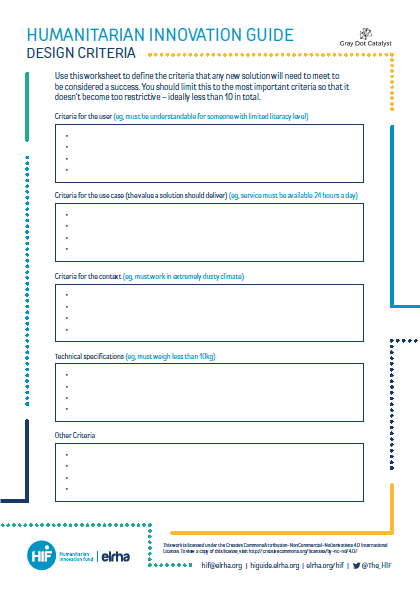
Design criteria provide specific guidance on the big questions that are at the heart of the problem and that require a solution. They also give a measuring stick with which to assess solutions when you search for them, or have to invent them.
The Citroen 2CV case study (above) provides an excellent example of the factors you need to consider when coming up with your criteria:
- The user: Key aspects about the user
- The use case: The outputs that the user is looking for from the solution
- The context: What contextual factors will the solution have to handle?
- Technical specifications: These should be kept to the bare minimum. Technical specifications are ‘input’ level criteria, and so give us almost no guidance on outputs and impact. The tighter the specification, the narrower the search will be, the more constrained your innovations will be to the current way of doing things.
It is crucial to have ‘smart criteria’, ie, criteria that – if fulfilled – will lead to other benefits. Again, in the 2CV example, by designing for ‘farmers’ with hats on, they were designing for tall adults. If the car worked for a tall adult, it should work for anyone who was a passenger.
Wherever possible, users should be involved in this process. If they cannot be directly involved, you should find a way of incorporating the views from your Starting Point Assessment.
Design Criteria
In the Recognition stage you developed a set of design criteria to guide the development of your solution. This remains a vital record of the specifications that a successful innovation will likely need to fulfil. Use your design criteria to assess your concepts. If your concepts do not look like they will fulfil important criteria, you need to consider rejecting them as the basis for an appropriate solution.