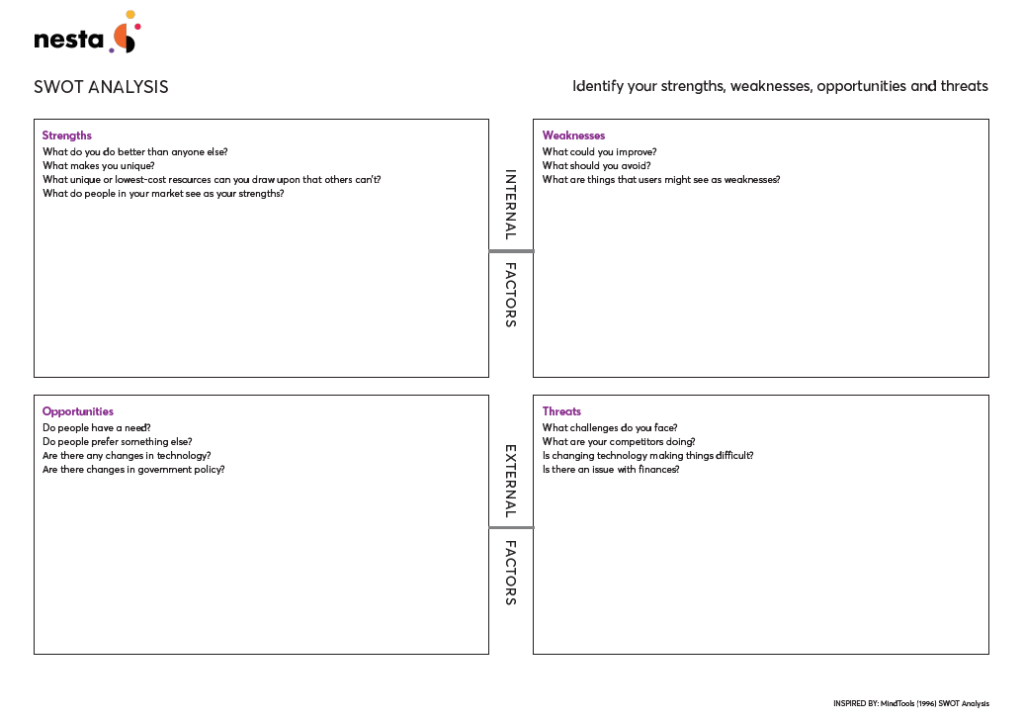
A SWOT analysis will enable you to identify strengths, weaknesses, opportunities and threats at the organisational level. Process mapping will enable you to understand weaknesses and potential areas for improvement with regards to particular organisational practices. To carry out these activities you will need to bring together relevant people from within your organisation.
SWOT Analysis
SWOT Analysis (strengths, weaknesses, opportunities and threats) is a tried and tested tool for analysing a project, organisation or even an entire sector.
According to Nesta’s DIY Toolkit, carrying out a SWOT Analysis “leads to a richer understanding of what the project or organisation can offer, the key weaknesses that need to be worked upon in order to succeed, and where to bring in external partners for assistance.”
It can be used to generate useful insights at different levels (HQ or in-country) and with different challenges, ideas or timeframes in mind, and it is therefore a good framework for evaluating strategies or feeding into reflections on the initial impressions of a problem.
At in-country level strengths and weaknesses can change quickly over time and so a SWOT analysis could yield very different insights from an organisational perspective depending on where you are in the disaster management cycle.
For example, you may have significant funding (strength) in the response phase but insufficient numbers of skilled staff (weakness), whereas in the reconstruction phase you may see cuts in funding (threat) but increased political support for disaster risk reduction programming (opportunity).
Read the instructions provided on the DIY Toolkit website, download and print out the template as large as possible (or draw it onto a flipchart) and use sticky notes to map out the internal and external factors that are helping or hindering you in achieving your goals.
Process Mapping
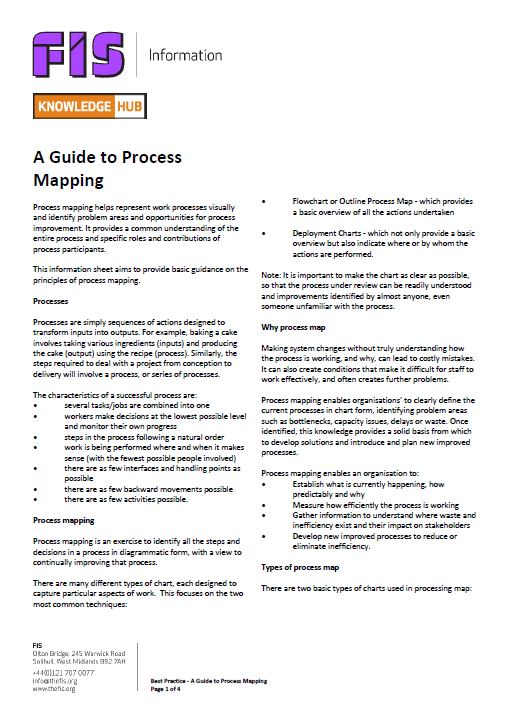
According to the FIS, “process mapping helps represent work processes visually and identify problem areas and opportunities for process improvement. It provides a common understanding of the entire process and specific roles and contributions of process participants.”
Download the FIS Best Practice Guide for Process Mapping below, familiarise yourself with the contents and plan a group exercise to map out the high-level process you anticipate. On a separate piece of flipchart paper, log any dependency or interaction with an established process in your organisation/s, and note any missing processes that will need to be developed in support of the high-level process you are creating.