You now have a rich collection of information on context, past efforts or existing services, and the problem at hand. But here we need to move from the what (which is largely a function of exploratory and evaluative analysis) to the why (a function of explanatory analysis).
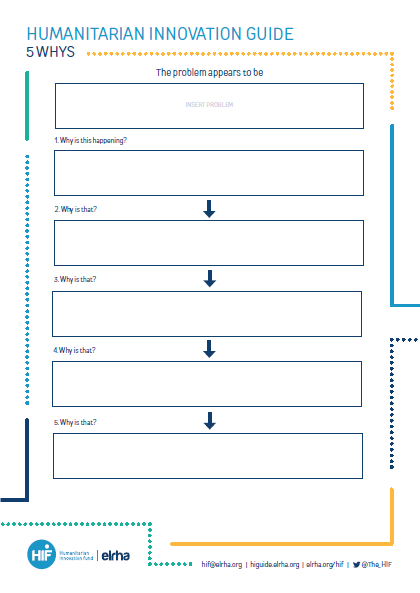
To do this, we recommend using the 5 Whys to look at causality. Working in groups, or in pairs, take turns digging into why your problem is happening by working progressively through the whys. One person should play the role of problem holder, and another person should play the role of the interviewer.
The problem holder should introduce the problem, and interviewer asks ‘Why is this happening?’ The problem holder should respond, the interviewer should record the answer on the template or flipchart paper, and the group should discuss and debate the answer. It should be plausible (likely), credible (reliable), backed by evidence, and objective (ie, not subjective). Again, the interviewer asks ‘Why is that?’ followed by a response and further discussion. This process repeats for a total of five responses, or ‘levels’.
This can be a difficult exercise to facilitate. It can be hard or uncomfortable for participants to come up with so many answers if they are not used to thinking in this way (for example, in countries where rote learning is common). The repeat questioning involved in the 5 Whys can also be inappropriate in some cultural contexts, particularly across social hierarchies. If you are organsing or facilitating this exercise be sure to clearly state the purpose and expectations.
There can also be a tendency in the humanitarian sector to just blame ‘the system’, without making the effort to be more specific and identify exactly what the ‘systemic’ issues are. Similarly, be wary of falling into the dead-end trap of blaming ‘lack of funds’. Make sure that you are specific in your answers and encourage creativity.