Toolkit
Unknown Knowns
First, drawing from your new understanding of the three Knowledge Areas (problem; context; past and current efforts) and how to formulate exploratory and evaluative research questions, independently write down a list of research questions that you’d like to have answered. Everyone in the group should write 2 or 3 questions on sticky notes (this should take about 5–10 minutes).
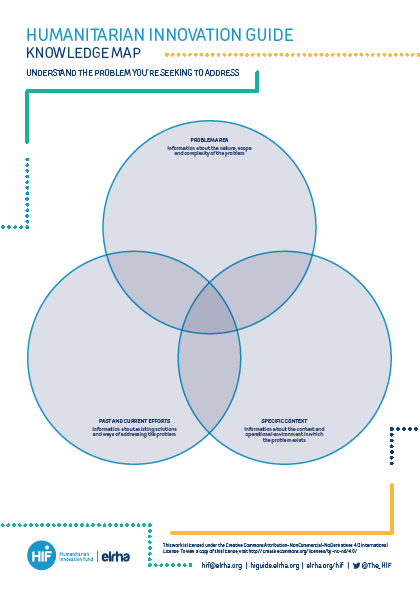
Next, share your questions with the rest of the group, going around the table; just present them, and move on to the next person. At this point, someone should collect the questions and place them on the Knowledge Map Venn diagram on a wall where everyone can see. (Either print out the template provided in A1 size, or draw it onto flipchart paper.)
After the questions are up on the wall, the group should gather around the wall and try to answer as many questions as possible – the more diverse your team is, the more likely you’ll be able to answer the exploratory and evaluative questions about context, challenge, and past efforts.
Answers should be based on evidence! If anyone thinks they know an answer to a question posed, they should feel free to share with a group and if the group is confident it is an answer with evidence behind it, they write down the answer directly on the sticky note.
Take stock of what has been answered. Those questions should be left on the Knowledge Map. These are your ‘known knowns‘ (what you know), and your ‘unknown knowns‘ (what others in your team and organisation know).
Remove the remaining questions – those that the group can’t confidently answer – and place them on a new Knowledge Map. These will be prioritised in the following activity when you will figure out how your team will generate the information needed to answer the questions.