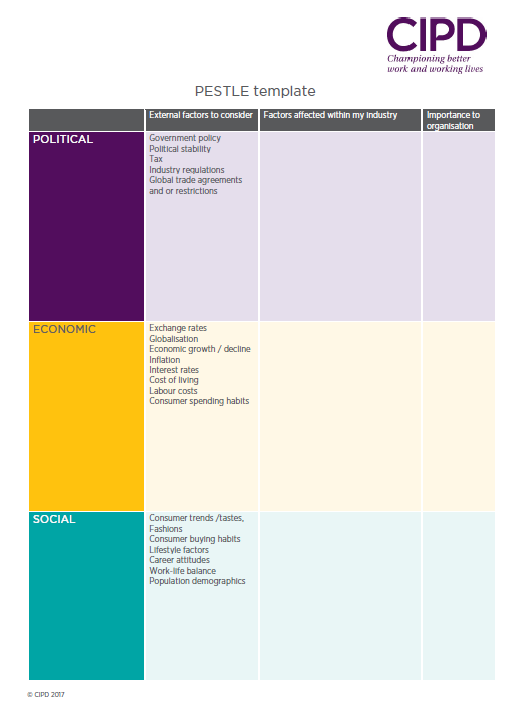
PESTLE analysis is the analysis of trends and factors that can affect the context in which humanitarian action is carried out and/or your organisation as a whole. It requires the user to look at six different domains: political, economic, social, technological, legal and environmental.
When carrying out a PESTLE analysis, pay particular attention to the political, economic and social factors that can result in power dynamics that have a negative impact on the affected population and particularly vulnerable groups.
While there are a number of versions of this tool that have fewer domains (PEST, STEEP), we would recommend using PESTLE so as to ensure inclusion of legal and environmental factors. The legal situation can be critical for innovation, whether it is around organisational registration, or the ability to protect intellectual property such as patents. Also include here any humanitarian principles that might be affected by the trends you uncover. Consider the potential impacts of climate change or other natural hazards in the environment section.
The result of a PESTLE analysis is a document that enables you to identify trends and understand opportunities and threats at a macro level. In this way it can be used as a precursor to a SWOT analysis (the outcomes can be used to populate the ‘opportunity’ and ‘threats’ segments of the SWOT analysis) and for scenario planning (see following exercise).